This promotional website is
intended for UK healthcare professionals only

This promotional website is intended for UK healthcare professionals only
- Adverse event reporting
- UK Prescribing Information
- Contact us
ENHERTU (trastuzumab deruxtecan) as monotherapy is indicated for the treatment of adult patients with unresectable or metastatic HER2-positive breast cancer who have received one or more prior anti-HER2-based regimens1
ENHERTU as monotherapy is indicated for the treatment of adult patients with unresectable or metastatic HER2-low breast cancer who have received prior chemotherapy in the metastatic setting or developed disease recurrence during or within 6 months of completing adjuvant chemotherapy1
Enhertu has a Conditional Marketing Authorisation
Special warnings and precautions for use

Interstitial lung disease (ILD)/pneumonitis
Cases of ILD and/or pneumonitis have been reported with ENHERTU.1 See interstitial lung disease (ILD)/pneumonitis section for more information.

Neutropenia
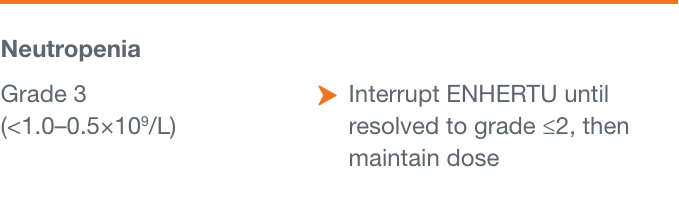
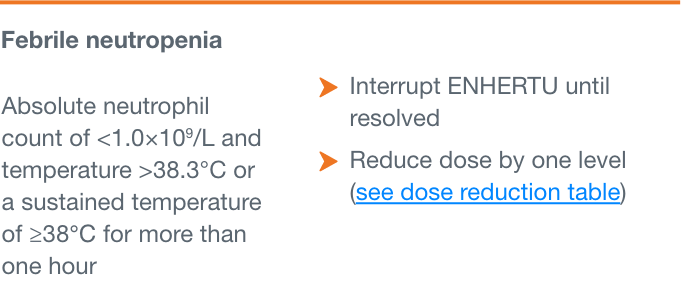
Cases of neutropenia, including febrile neutropenia, were reported in clinical studies of ENHERTU. Complete blood counts should be monitored prior to initiation of ENHERTU and prior to each dose, and as clinically indicated. Based on the severity of neutropenia, ENHERTU may require dose interruption or reduction.1 See dose modifications for management of neutropenia.

Left ventricular ejection fraction (LVEF) decrease
LVEF decrease has been observed with anti-HER2 therapies. Standard cardiac function testing (echocardiogram or MUGA scanning) should be performed to assess LVEF prior to initiation of ENHERTU and at regular intervals during treatment as clinically indicated.1 See dose modifications for management of LVEF.

Embryo-foetal toxicity
ENHERTU can cause foetal harm when administered to a pregnant woman, therefore use during pregnancy is not recommended. Pregnancy status should be verified prior to initiating ENHERTU in women of childbearing potential. Women of reproductive potential should be advised to use effective contraception during treatment and for at least 7 months following the last dose of ENHERTU. Male patients with female partners of reproductive potential should be advised to use effective contraception during treatment with ENHERTU and for at least 4 months after the last dose of ENHERTU.1

Renal impairment
The potential need for dose adjustment in patients with severe renal impairment or end-stage renal disease cannot be determined as severe renal impairment was an exclusion criterion in clinical studies. Patients with moderate or severe renal impairment should be monitored carefully for adverse reactions including ILD/pneumonitis.

Patients with moderate or severe hepatic impairment
There are limited data in patients with moderate hepatic impairment and no data in patients with severe hepatic impairment. As metabolism and biliary excretion are the primary routes of elimination of the topoisomerase I inhibitor, DXd, ENHERTU should be administered with caution in patients with moderate or severe hepatic impairment.1
This list is not exhaustive. Please consult the SmPC for further information.
Abbreviations
DXd, deruxtecan derivative; HER2, human epidermal growth factor receptor 2; ILD, interstitial lung disease; LVEF, left ventricular ejection fraction; MUGA, multigated acquisition.
Interstitial lung disease (ILD)/pneumonitis
Patients and healthcare professionals should be aware of the risk of ILD and how to promptly identify and report the symptoms in order to initiate appropriate management.
Monitor patients for ILD/pneumonitis and promptly investigate the signs and symptoms2
Questions to aid early identification of ILD/pneumonitis:2

Cough
- Have you been coughing recently? Is it a dry cough?
- Have you had any shortness of breath, especially during or after physical activity?
- Do you smoke or use e-cigarettes?

Dyspnoea, new or worsening respiratory symptoms
- Have you experienced any new breathing or respiratory problems?
- If you already have respiratory problems, have they become worse?

Fever
- Have you had a fever?
- Have you been feeling tired?
Diagnosis and management of ILD/pneumonitis1,3
Any evidence of ILD/pneumonitis should be promptly investigated1,3
Grade 1 – Asymptomatic
Diagnosis
Typically identified as an incidental finding of radiographic changes3
Treatment modifications
Withhold ENHERTU until recovery (resolved to grade 0)*5
Toxicity Management
Consider initiating systemic steroids (e.g. ≥0.5mg/kg/day prednisone or equivalent) until complete resolution of clinical symptoms and chest HRCT findings, followed by gradual taper over at least 4 weeks5
Monitor and closely follow up in 2–7 days for onset of clinical symptoms and pulse oximetry.5
Consider follow-up imaging in 1–2 weeks (or as clinically indicated).5
If diagnostic observations continue to worsen despite initiation of corticosteroids, then follow Grade 2 guidelines.5
*If resolved to Grade 0
- If resolved in ≤28 days from date of onset, maintain dose.5
- If resolved in >28 days from date of onset, reduce dose one level.5
- If ILD/pneumonitis occurs beyond day 22 and has not resolved within 49 days from the last infusion, discontinue ENHERTU.5
Grade 2 – Symptomatic
Diagnosis
Acute onset of new or worsening pulmonary or other related signs / symptoms such as dyspnoea, cough or fever 3

Treatment modifications
Permanently discontinue ENHERTU in patients who are diagnosed with any symptomatic (≥ grade 2) ILD / pneumonitis5
Toxicity Management
Initiate systemic steroids (e.g. ≥1.0 mg/kg/day prednisone or equivalent) until complete resolution of clinical symptoms and chest HRCT findings, followed by gradual taper over at least 4 weeks.5
Monitor symptoms closely.5
Re-image as clinically indicated.5
If worsening or no improvement in clinical or diagnostic observations in 5 days:
- Consider increasing dose of steroids (e.g. 2.0 mg/kg/day prednisone or equivalent) and administration may be switched to IV (e.g. methylprednisolone) followed by a gradual taper over at least 4 weeks.5
- Re-consider additional work-up for alternative aetiologies as described above.5
- Escalate care as clinically indicated.5
Grade 3 – Symptomatic
Diagnosis
Severe pulmonary symptoms limiting self-care activities of daily living; oxygen indicated4
Treatment modifications
Permanently discontinue ENHERTU in patients who are diagnosed with any symptomatic (≥ grade 2) ILD / pneumonitis5
Toxicity Management
Initiate empiric high-dose methylprednisolone IV treatment (e.g. 500–1,000 mg/day for 3 days), followed by ≥1.0 mg/kg/day of prednisone (or equivalent) until complete resolution of clinical symptoms and chest HRCT findings, followed by gradual taper over at least 4 weeks. 5
Hospitalisation required. 5
Re-image as clinically indicated. 5
If still no improvement within 3 to 5 days:
- Re-consider additional work-up for alternative aetiologies as described above. 5
- Consider other immuno-suppressants and/or treat as per local practice. 5
Grade 4 – Symptomatic
Diagnosis
Life-threatening respiratory compromise4

Treatment modifications
Permanently discontinue ENHERTU in patients who are diagnosed with any symptomatic (≥ grade 2) ILD / pneumonitis5
Toxicity Management
Initiate empiric high-dose methylprednisolone IV treatment (e.g. 500–1,000 mg/day for 3 days), followed by ≥1.0 mg/kg/day of prednisone (or equivalent) until complete resolution of clinical symptoms and chest HRCT findings, followed by gradual taper over at least 4 weeks. 5
Hospitalisation required. 5
Re-image as clinically indicated. 5
If still no improvement within 3 to 5 days:
- Re-consider additional work-up for alternative aetiologies as described above. 5
- Consider other immuno-suppressants and/or treat as per local practice.5
Adapted from US Department of Health and Human Services, 2017; Swain, 2022; and UKBCG✝︎, 2024
✝︎These guidelines have been developed by the UKBCG in collaboration with national ILD experts. The funding and facilitation of these guidelines was provided by Daichii Sankyo and AstraZeneca. Management decisions should be directed by the SmPC and clinical discretion.
Further information and guidance on the management of ILD can be found in the following ENHERTU risk minimisation materials:
1. Patient Guide
2. HCP Card
Ensure that all patients on ENHERTU receive the Patient Card, with contact details for their oncologist and nurse, and their 24/7 oncology support service.
Electronic versions of the risk minimisation materials are available to download from the electronic medicines compendium at: www.medicines.org.uk/emc. Hard copy items are available on request from your local Daiichi Sankyo or AstraZeneca representative or from Daiichi Sankyo Medical Information at: medinfo@daiichi-sankyo.co.uk or on 0800 028 5122.
Abbreviations
HRCT, high-resolution computed tomography; ILD, interstitial lung disease; IV, intravenous; UKBCG, UK Breast Cancer Group.
Dose modification
Adverse reactions with ENHERTU may be managed by temporary interruption, dose reduction or treatment discontinuation.1
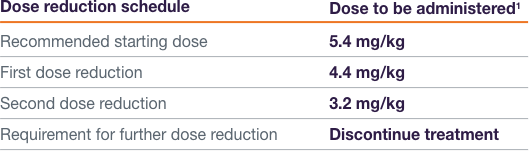

Do not re-escalate the ENHERTU dose after a dose reduction is made.1

If a planned dose is delayed or missed, administer ENHERTU as soon as possible without waiting until the next planned cycle. The schedule of administration should be adjusted to maintain a 3-week interval between doses. Administer the infusion at the dose and rate that the patient tolerated in the most recent infusion.1
Dose modifications for the management of specific adverse events*1



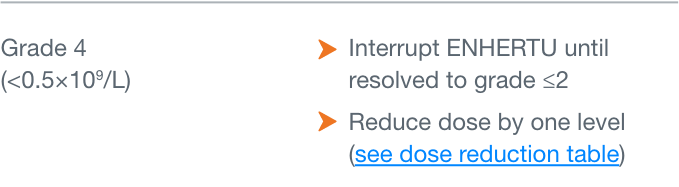
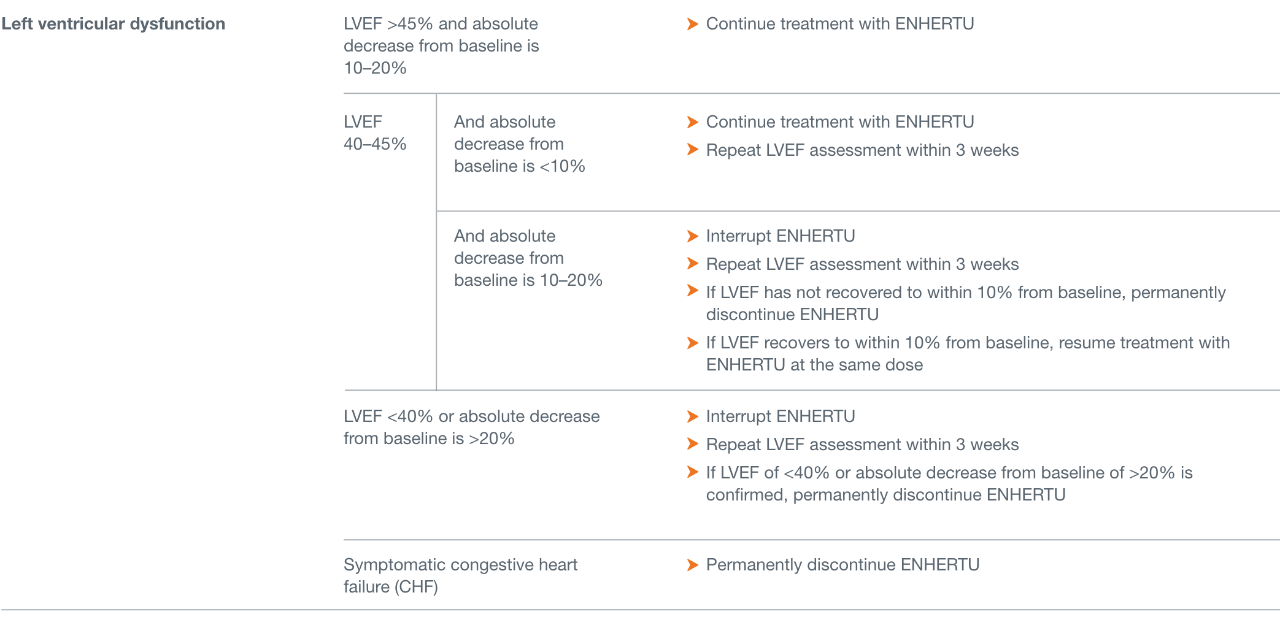
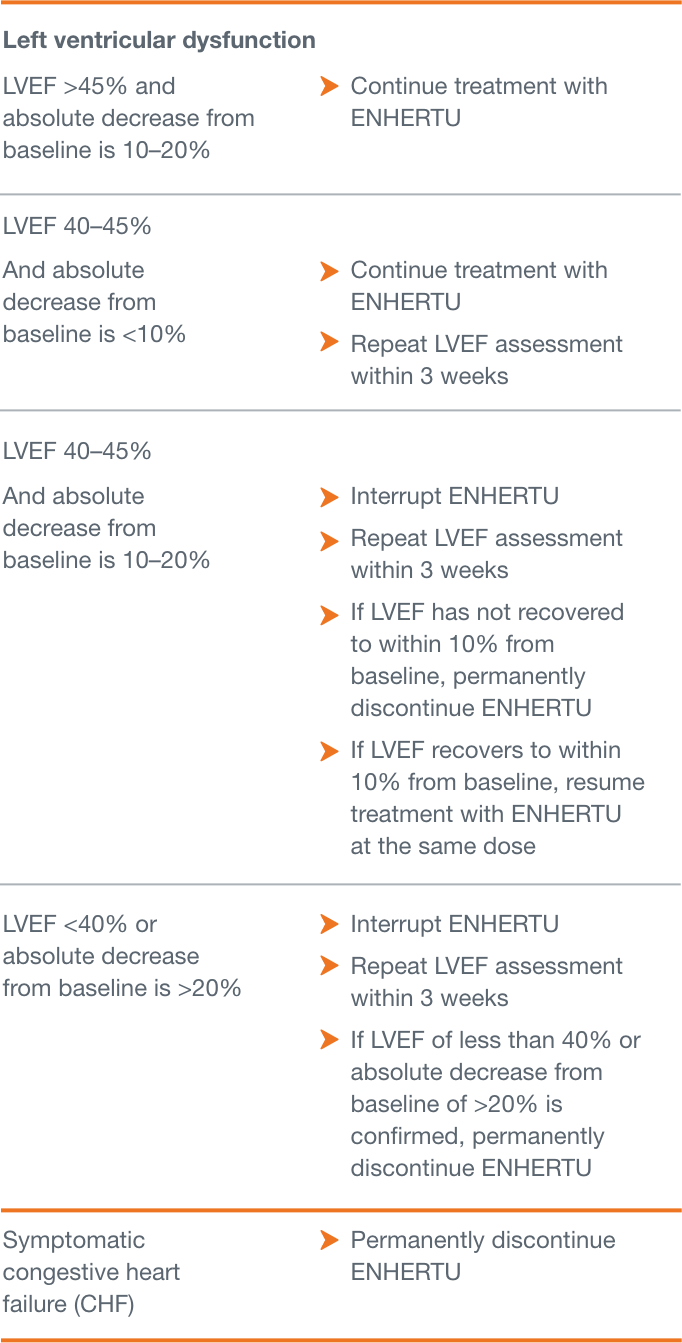
*Toxicity grades are in accordance with National Cancer Institute Common Terminology Criteria for Adverse Events version 5.0 (NCI-CTCAE v.5.0).1
Abbreviations
CHF, congestive heart failure; LVEF, left ventricular ejection fraction; NCI-CTCAE, National Cancer Institute Common Terminology Criteria for Adverse Events.
Adverse events should be reported. Reporting forms and information can be found at https://yellowcard.mhra.gov.uk/ or search for MHRA Yellow Card in Google Play or Apple App store. Adverse events should also be reported to Daiichi Sankyo UK Pharmacovigilance on 0800 028 5122 or by email to pharmacovigilance@daiichi-sankyo.co.uk. As ENHERTU is a biological medicine, healthcare professionals should report adverse reactions by brand name and batch number.
References
- ENHERTU (trastuzumab deruxtecan). Summary of Product Characteristics.
- ENHERTU risk minimisation materials. HCP Guide: Important safety information on ILD/pneumonitis with treatment of ENHERTU. Available at: https://www.medicines.org.uk/emc/product/12135/rmms. Last accessed: March 2025.
- Swain SM, et al. Cancer Treat Rev. 2022;106:102378.
- US Department of Health and Human Services. Common Terminology Criteria for Adverse Events (CTCAE) Version 5.0. 2017. Available at: https://ctep.cancer.gov/protocoldevelopment/electronic_ applications/docs/ctcae_v5_quick_reference_5x7.pdf. Last accessed March 2025.
- UK Breast Cancer Group (UKBCG) 2024. UK Guidance for the monitoring and management of ENHERTU®▼(trastuzumab deruxtecan)-related ILD (interstitial lung disease), available at https://ukbcg.org/guidelines/. Accessed March 2025.
UK/ADC/01/25/0010 | March 2025